Helical Fusion Stellarator Architecture Partners with Hazama Ando
Helical Fusion partners with general contractor Hazama Ando to advance its Helical Fusion Stellarator Architecture and construct the Helix KANATA pilot plant.
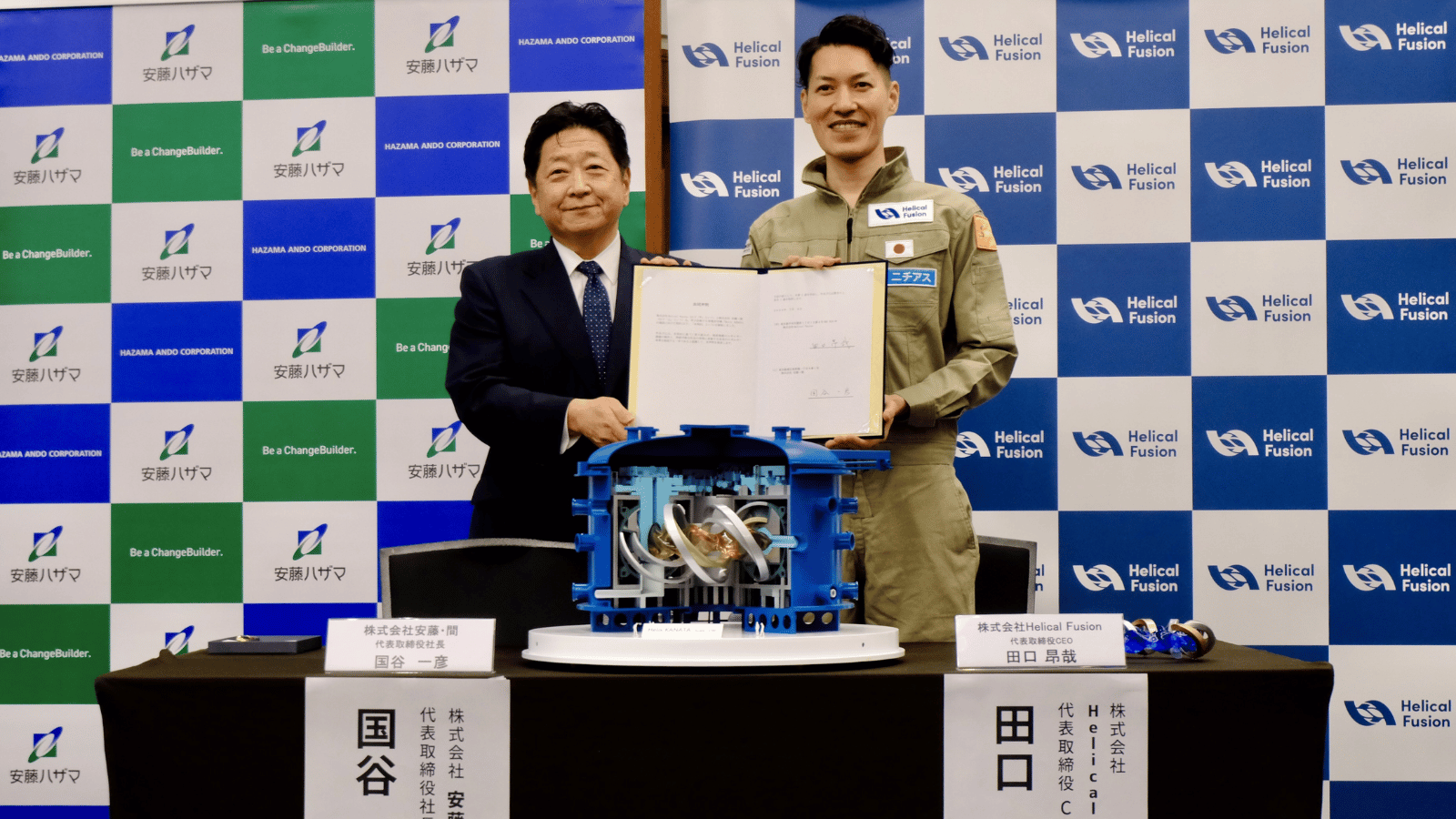
The Helical Fusion Stellarator Architecture entered a critical commercial engineering cycle on Monday as nuclear energy developer Helical Fusion Co., Ltd. announced a strategic partnership and Memorandum of Understanding (MoU) with established Japanese general contractor HAZAMA ANDO CORPORATION. The industrial agreement integrates Hazama Ando as an Official Partner within the startup’s centralized “Helix Program,” an ongoing technology roadmap focused on delivering commercially viable fusion power to regional electrical grids. By combining advanced magnetic-confinement plasma physics with heavy civil infrastructure development, the corporate alliance intends to outline precise construction parameters and project execution frameworks for “Helix KANATA,” a commercial fusion pilot plant slated for initial deployment in the 2030s.
The corporate strategy behind the industrial coalition addresses the steep engineering transition required to migrate fusion concepts away from isolated academic laboratories into scaled, continuous-operation utility facilities. While the nuclear science community has verified the basic physical principles of magnetic plasma confinement, building a commercially viable reactor demands heavy-duty structural shielding, complex cryogenic containment shielding, and automated heat-exchange plumbing. Partnering with a tier-one infrastructure contractor allows the energy startup to inject real-world civil engineering capabilities, concrete supply-chain logistics, and large-scale project management methodologies directly into its early-stage design matrices.
The underlying technology configuration centers on the Helical Stellarator approach, an advanced magnetic-confinement fusion concept developed to sustain continuous power generation without the plasma instabilities that frequently disrupt alternative tokamak architectures. The architectural foundation builds on approximately 70 years of public research harvested alongside the National Institute for Fusion Science (NIFS) and its Large Helical Device (LHD), which achieved continuous plasma sustainment for 3,268 seconds and core temperatures exceeding 100 million degrees Celsius. Utilizing continuous helical magnetic coils allows the system to maintain a stable, self-regulating plasma loop indefinitely, providing a predictable, long-term alternative to traditional primary energy resources.
Constructing Grid-Scale Infrastructure via the Helix Program Matrix
The inclusion of Hazama Ando marks a strategic expansion of Helical Fusion’s multi-tiered “Official Partner” industrial framework, which launched in early 2026 to consolidate capital allocations and technical manufacturing resources from major industrial stakeholders. The unified builder group—which includes initial corporate members NICHIAS Corporation, Hasetora Spinning Co., Ltd., and Seno Kisen Co., Ltd.—works synchronously to manufacture and deploy specialized hardware components. The immediate operational roadmap directs these collaborative engineering teams to build “Helix HARUKA,” an Integrated Demonstration Device designed to field-test core superconducting magnet matrices before breaking ground on the full pilot plant.
Enterprise energy procurement officers, utility asset managers, and national infrastructure planners track these commercial fusion milestones to insulate future regional distribution grids from fossil-fuel resource dependencies and carbon accounting penalties. The long-term commercial validity of the platform’s utility model was previously validated by a historic Power Purchase Agreement (PPA) finalized alongside Japanese supermarket network Aoki Super, marking the nation’s first corporate commitment to purchase future fusion-derived electricity. Implementing pre-validated, heavy civil deployment frameworks helps the energy developer de-risk early-stage capital construction timelines, accelerating commercial market readiness.
Continuous Plasma Stability: Unlike standard pulsed tokamak designs that suffer from extreme structural stress due to intermittent inductive currents, the Helical Stellarator architecture utilizes twisted, continuous superconducting coils to maintain an uninterrupted, steady-state plasma equilibrium, maximizing structural hardware lifespan.
The internal data processing and structural mapping pipelines prioritize strict configuration control and multi-system validation to comply with national nuclear and industrial safety standards. The joint engineering teams utilize advanced spatial simulation software to analyze complex concrete radiation shielding thickness, seismic reinforcement metrics, and thermal load distributions around the core stellarator vessel, translating complex plasma dynamics into immutable structural blueprints. This focus on heavy civil safety parameters ensures that future commercial installations can be integrated safely into existing municipal industrial corridors, preserving complete data and structural integrity.
Accelerating Component Manufacturing through Public-Private Spin-Outs
The operational lifecycle of the Helix technology ecosystem relies on deep integration with public research legacies, functioning as an agile commercial vehicle to scale assets originally incubated within Japan’s national laboratory network. By backing early-stage thermodynamic and electromagnetic research with the global supply-chain access and construction management software of established general contractors, the startup compresses typical laboratory-to-market development loops. This coordinated incubation model enables the joint enterprise to establish highly precise component specifications, streamlining the transition toward high-volume commercial factory production.
Securing Base-Load Power Through Autonomous Technological Horizons
The long-term commercial viability of global fusion energy installations will ultimately depend on how successfully developer groups can move from conceptual laboratory papers to integrated, repeating civil construction projects. As international energy systems face ongoing volatility and localized industrial centers require reliable, 24/7 zero-emission base-load power, the transition toward advanced technological energy sources will continue to govern institutional capital deployment. The systematic expansion of the Helix Program framework establishes a clear international benchmark, demonstrating a unified blueprint where advanced magnetic confinement engineering and macro civil construction combine to deliver stable, clean power at global scale.