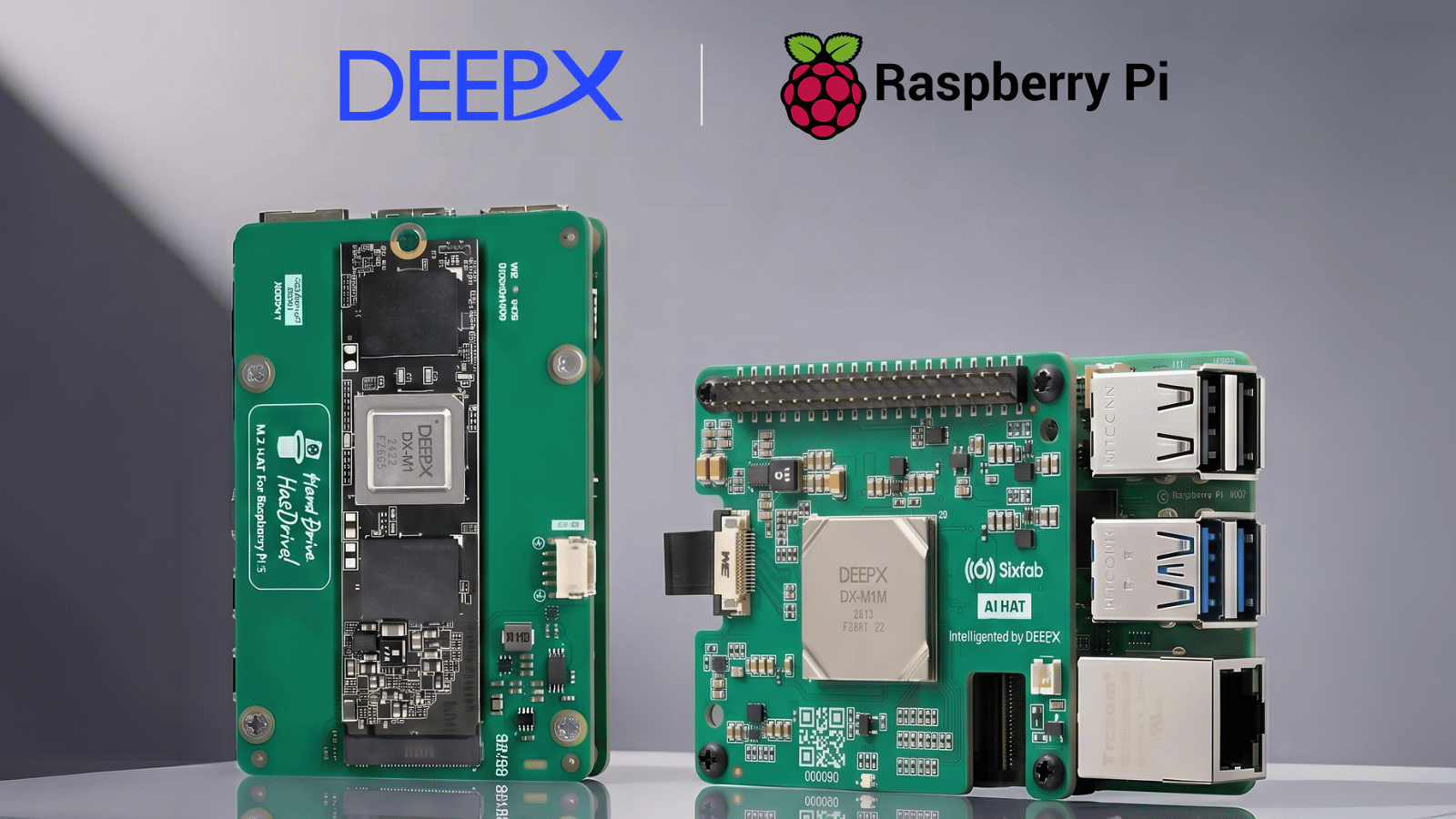
DEEPX AI HAT Brings Physical AI to Raspberry Pi 5
DEEPX and Sixfab launch the DEEPX AI HAT module for the Raspberry Pi 5, delivering ultra-low-power physical AI and neural processing for edge computing.
The DEEPX AI HAT expansion board entered commercial distribution on Friday as on-device artificial intelligence developer DEEPX finalized a manufacturing collaboration with edge hardware solutions provider Sixfab and the Raspberry Pi Foundation. The specialized hardware attached on top module integrates a proprietary neural processing unit designed to execute complex embedded machine learning models locally without relying on continuous cloud data processing connections. By bringing high performance inference capabilities directly to the physical edge, the joint development allows industrial engineers to deploy intelligent automation tasks across power constrained environments including robotics, smart agriculture nodes, and factory assembly lines.
The corporate strategy behind the hardware rollout addresses the processing bottlenecks that frequently stall the deployment of automated computer vision applications in remote commercial settings. Standard microprocessors struggle to handle real time object detection and spatial segmentation workloads without generating excessive thermal output or draining localized battery reserves rapidly. Deploying a dedicated silicon accelerator directly onto the standard single board computing footprint allows field operators to shift complex analytical workloads off the primary central processing unit, maintaining real time operational speeds while operating within strict thermal and electrical envelopes.
The underlying technical framework utilizes an automated compiling software suite designed to compress and translate standard neural network models into highly optimized proprietary execution formats. The hardware platform connects to the host computer through a dedicated peripheral component interconnect express interface, utilizing a specialized flexible flat cable to bypass traditional input output limitations. This direct data link ensures that multi-layered artificial intelligence models can process incoming high definition video feeds with minimal latency, transforming static endpoints into active physical AI execution nodes.
Scaling Edge Intelligence via the DEEPX AI HAT Infrastructure
The introduction of the DEEPX AI HAT hardware reflects a broader structural transition within the industrial automation sector, where technology directors increasingly favor decentralized processing architectures over centralized cloud analytics. Historically, remote sensor networks transmitted raw video feeds and telemetry data to remote server clusters for analysis, an arrangement that introduced significant latency risks and exposed proprietary industrial data to external transmission vulnerabilities. Integrating high density neural processing capabilities directly at the physical endpoint allows corporate operators to process sensitive diagnostic information locally, satisfying strict corporate data security protocols.
Enterprise engineering teams and industrial systems integrators track these localized processing benchmarks to determine the long term viability of automated monitoring networks across extensive field deployments. When an industrial robotics platform relies entirely on wireless data links to interpret its surroundings, minor network interruptions can cause critical machinery to freeze or misinterpret spatial boundaries. Implementing self-contained, low power inference engines ensures that remote hardware continues to operate autonomously during network outages, protecting overall production continuity in isolated commercial environments.
Streamlining Model Deployment through Developer SDKs
The administrative management of edge computing nodes relies on a comprehensive software development kit that standardizes the compilation and deployment of complex vision models. The integrated toolkit allows software engineers to port existing machine learning pipelines built on popular commercial frameworks directly into the embedded environment without undertaking extensive manual code reconstruction. Providing developers with a seamless translation pathway helps corporate engineering teams accelerate their prototyping cycles, moving advanced physical AI concepts from laboratory testing into active field deployment efficiently.
Democratizing Physical AI Across Decentralized Hardware
The broader commercial utility of embedded neural processing hardware connects directly to the rising demand for intelligent automation across cost sensitive economic sectors. Because traditional discrete graphics processing units remain prohibitively expensive and thermally unsuitable for small scale deployments, developers require highly efficient alternatives to bring automated analytics into everyday commercial tools. Supplying standard industrial computing platforms with affordable, high throughput acceleration modules lowers the barrier to entry for widespread automation, driving physical AI integration into smaller form factor devices.
The long term commercial viability of edge computing ecosystems will ultimately depend on how successfully hardware developers can balance intense computational demands with strict power limitations. As intelligent robotics and autonomous monitoring networks scale across urban environments and industrial facilities, the underlying hardware must execute increasingly complex decision making algorithms without demanding massive battery packs. The comprehensive rollout of the DEEPX AI HAT architecture underscores a definitive transition toward hyper efficient, localized silicon solutions that prioritize autonomous decision making at the extreme physical edge.