rabbit OS3 Agentic Operating System Launches to Unify Multi-Device Control and Agentic Workflows
rabbit unveils the rabbit OS3 agentic operating system, featuring multi-device orchestration, universal skills compatibility, and direct computer control.
News About rabbit OS3 Agentic Operating System
Santa Monica, California-based AI hardware and software company rabbit inc. unveiled the rabbit OS3 agentic operating system, marking the evolution of its proprietary agentic ecosystem from dedicated handheld hardware into an open, device-spanning platform. Managed via a conversational unified interface, the system determines optimal execution pathways across connected machines rather than confining tasks to a single hardware unit.
The operating system runs in the cloud while interacting with local hardware environments through the lightweight rabbit agent, which can link up to five distinct devices per user profile across Windows, macOS, Linux, cloud virtual machines, and rabbit’s proprietary r1 device. Key architecture features include:
- One Identity Across Every Screen: Eliminates fragmented chat histories in favor of a persistent, single linear conversation thread that maintains background memory across multiple sessions and devices.
- Open Architecture and BYOK Support: Integrates a “Bring Your Own Key” framework allowing users to connect preferred API keys from leading frontier AI labs, cloud routing services, or locally hosted open-source models without losing active contextual memory.
- Universal Skill Compatibility: Enables instant capability ingestion by pasting any public skill URL directly into the conversation stream without manual command-line installation or system file adjustments.
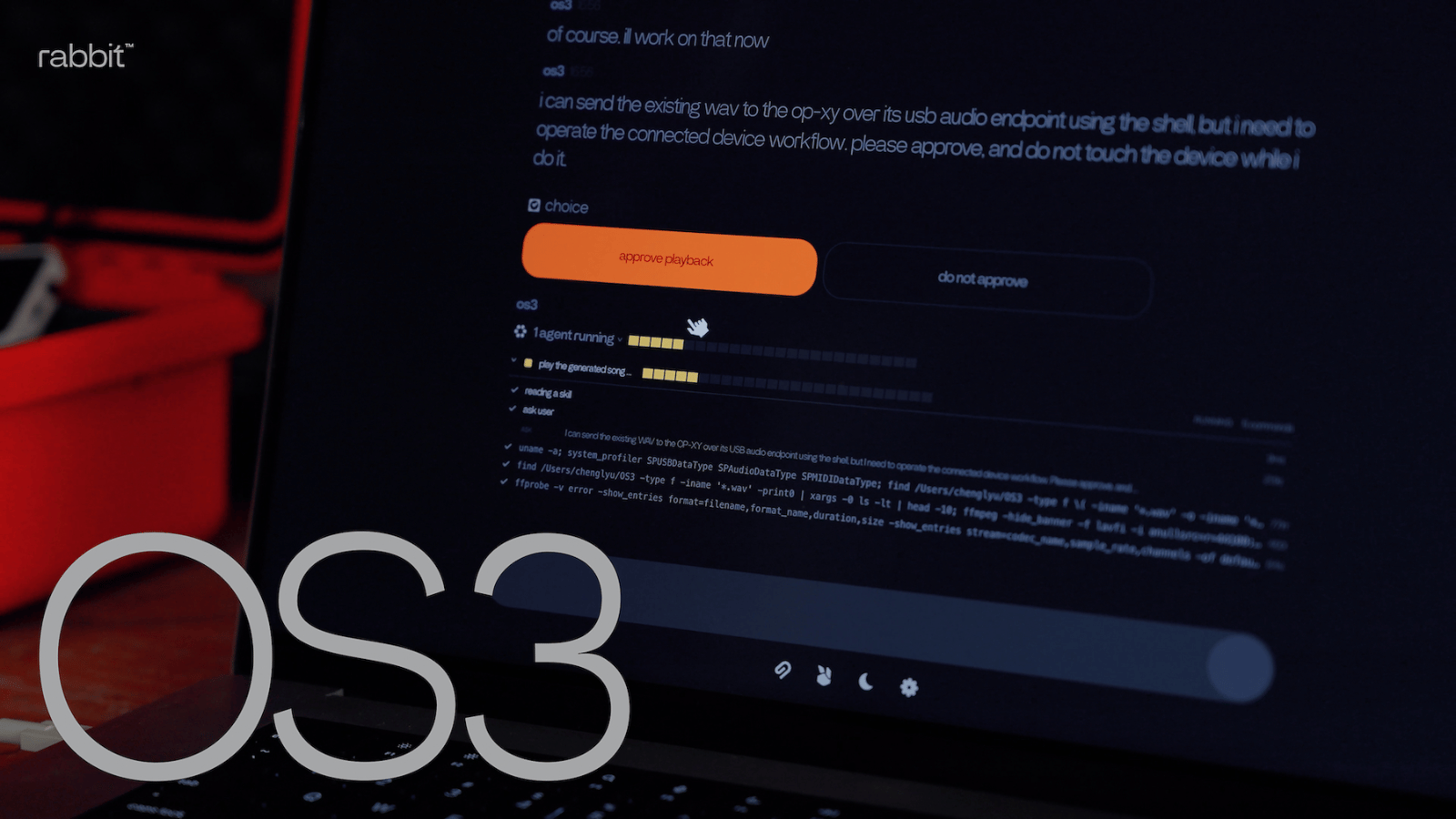
- Direct Computer Control (DCC) and Autonomous Coding: Leverages rabbit’s Large Action Model (LAM/DLAM) to operate native desktop software, web applications, and local file directories, alongside autonomous workflows for writing, testing, and debugging code.
- Local Privacy Protocols: Restricts local file access exclusively to the client machine running the agent, ensuring proprietary files remain stored locally rather than retained on rabbit servers, with sensitive operations requiring explicit user confirmation.
The launch is led by rabbit Founder and Chief Executive Officer Jesse Lyu. Access is available via desktop web onboarding at os3.rabbit.tech, with interaction channels spanning desktop and mobile browsers, paired Telegram bots, iMessage, RCS, SMS messaging, and the rabbit r1. The company confirmed that OS3 will also serve as the native operating system for its upcoming cyberdeck hardware.
Significance of rabbit OS3 Agentic Operating System
The rollout of the rabbit OS3 agentic operating system represents a notable shift in personal computing and generative software architecture. Conventional desktop operating systems remain largely passive, requiring human users to manually bridge siloed applications, manage file hierarchies, and execute repetitive operational steps across multiple screens.
By pairing large action models with a local daemon, OS3 transforms the operating system into an active executor. Users state a desired outcome—such as parsing spreadsheets, downloading receipts, or refactoring a web script—and the system coordinates the appropriate models and local desktop tools to complete the action autonomously.
Furthermore, decoupling the operating software from proprietary hardware addresses previous accessibility constraints associated with dedicated single-purpose devices. Introducing cross-platform support across Windows, Mac, and Linux while supporting external model keys allows technical power users and software developers to deploy agentic automation within their existing professional desktop setups.
Next Steps for rabbit OS3 Agentic Operating System
Following the general release, rabbit will onboard users through its unified web interface while rolling out supplementary input channels across mobile messaging platforms. Software engineering teams will continue optimizing agent latency and expanding the repository of verified community-developed skills.
Looking ahead, rabbit plans to release its specialized cyberdeck hardware, which will arrive with OS3 configured as its core operating software out of the box. Development will focus on deepening multi-screen orchestration capabilities, expanding enterprise permission controls, and refining DLAM precision for complex desktop desktop application suites.