OrcaRouter Launches Shield to Counter Offensive AI Agents With Active Cyber Deception
Artificial intelligence infrastructure and security provider OrcaRouter has officially announced that OrcaRouter launches Shield, an artificial intelligence native cybersecurity platform designed to defend web applications against autonomous offensive agents. Rather than relying solely on traditional signature detection and perimeter blocking, Shield transforms an organization’s exposed digital surface into a dynamic synthetic labyrinth that misleads automated attackers, corrupts their reasoning contexts, and exhausts their computational budgets.
News About OrcaRouter Launches Shield
San Francisco based artificial intelligence platform OrcaRouter confirmed that OrcaRouter launches Shield following heightened industry concern over automated cyberattacks, including a November 13 Federal Bureau of Investigation warning regarding the weaponization of the autonomous penetration testing framework ARTEX. Operating directly at the application edge, Shield inspects incoming requests while maintaining zero visual or functional impact on legitimate human visitors.
When suspicious reconnaissance probes attempt to enumerate sensitive directories such as environment configuration files or version control folders, Shield dynamically serves personalized synthetic attack surfaces tailored to the specific visitor. The platform introduces several specialized defensive mechanisms engineered to disrupt autonomous reasoning loops:
- Transparent Traffic Isolation. Legitimate users interact with the genuine production application byte for byte without latency penalties or interface modifications.
- Dynamic Synthetic Environments. Suspicious automated scanners encounter fabricated endpoints, decoy source maps, and artificial configuration files designed to mimic high value infrastructure targets.
- Context Poisoning for AI Reasoning. Shield injects carefully structured misinformation into retrieved artifacts, contaminating the working memory of large language model driven agents and steering their automated investigation down unproductive paths.
- Cryptographic Attacker Attribution. The platform generates decoy API keys and access tokens cryptographically bound to individual visitor sessions using HMAC signatures. When an offensive agent attempts to authenticate with a stolen decoy credential, Shield immediately identifies the originating source and triggers automated edge blocking.
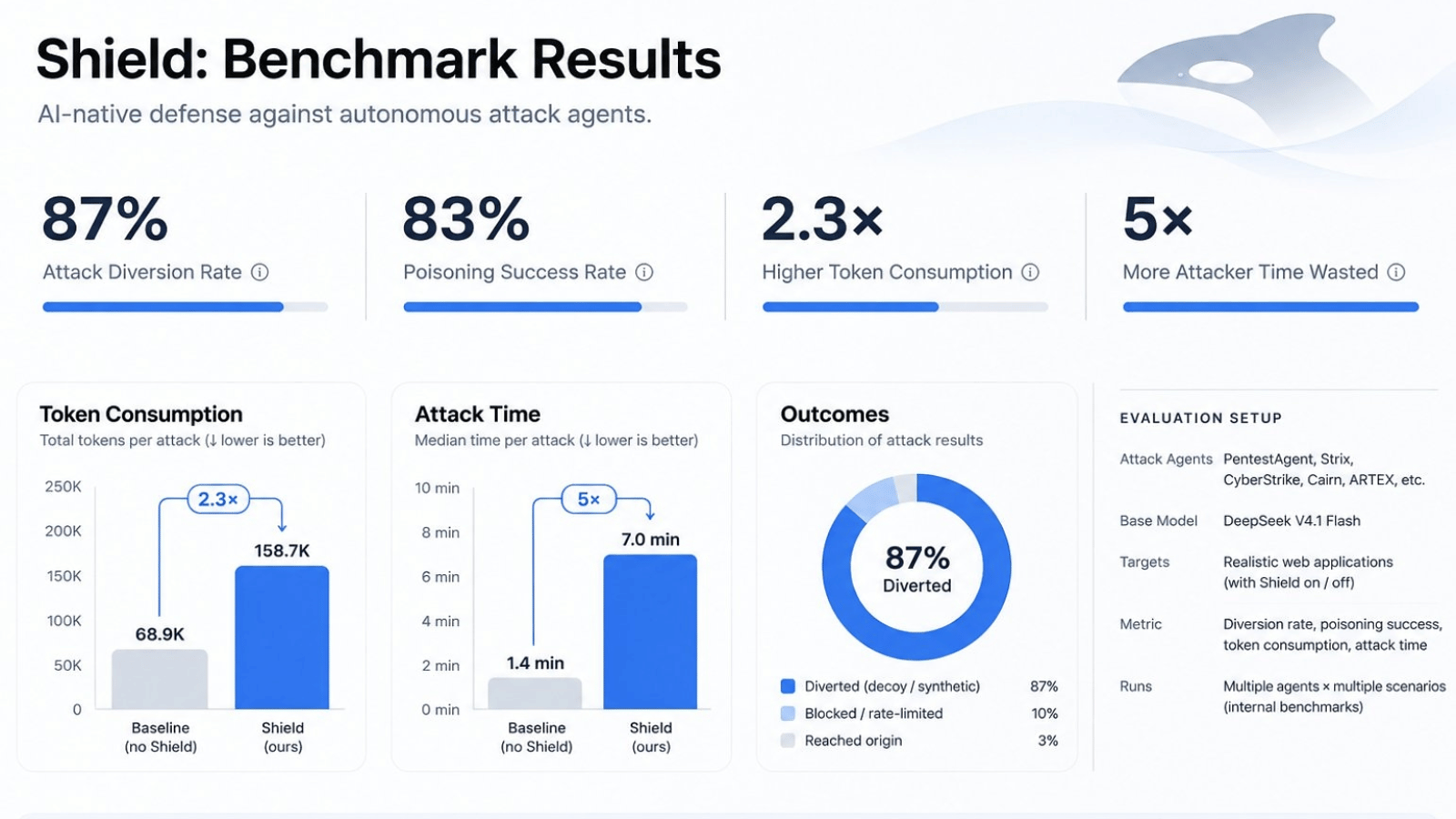
To validate the platform’s effectiveness, OrcaRouter evaluated Shield against leading autonomous offensive security frameworks including ARTEX, Strix, PentestAgent, CyberStrike, and Cairn, running tests with DeepSeek V4.1 Flash. Internal benchmark results demonstrated an 87 percent attack diversion rate, an 83 percent context poisoning success rate, a 2.3x increase in attacker token consumption, and a 5x increase in wasted offensive workflow duration. Shield is immediately accessible within the OrcaRouter user console across Team and Enterprise plans, supported by a free trial.
Significance of OrcaRouter Launches Shield
The development where OrcaRouter launches Shield is highly significant for enterprise chief information security officers, application security architects, and cloud infrastructure teams because offensive cyber operations have transitioned to machine speed. Autonomous penetration testing agents can map application architectures, test vulnerability chains, and chain exploits continuously without human fatigue.
Conventional web application firewalls and static honeypots struggle against modern reasoning agents. Simple IP blocking fails when attackers rotate through residential proxy networks, while static decoy servers are easily fingerprinted and bypassed by advanced language models capable of evaluating environmental consistency.
By exploiting the core architectural dependency of autonomous agents their reliance on retrieved environmental evidence to plan subsequent actions active deception turns the attacker’s own intelligence into a liability. Contaminating an agent’s context window forces threat actors to burn substantial inference compute and API tokens chasing fabricated vulnerabilities, dramatically altering the economic asymmetry of automated cyberattacks.
Next Steps for OrcaRouter Launches Shield
Following the commercial availability of Shield inside the OrcaRouter user console, engineering teams are onboarding enterprise security operations centers and application developers through no credit card trial deployments. Technical specialists will assist organizations in integrating Shield with existing web application firewalls to automate upstream IP blocking whenever decoy credentials are triggered.
Looking ahead, OrcaRouter plans to expand its OrcaCyber defensive suite by introducing deeper telemetry integrations, automated forensic evidence packs, and adaptive deception templates tailored to emerging multi agent attack frameworks. Development teams will continue refining dynamic context poisoning algorithms to stay ahead of next generation reasoning models deployed across automated offensive security toolkits.