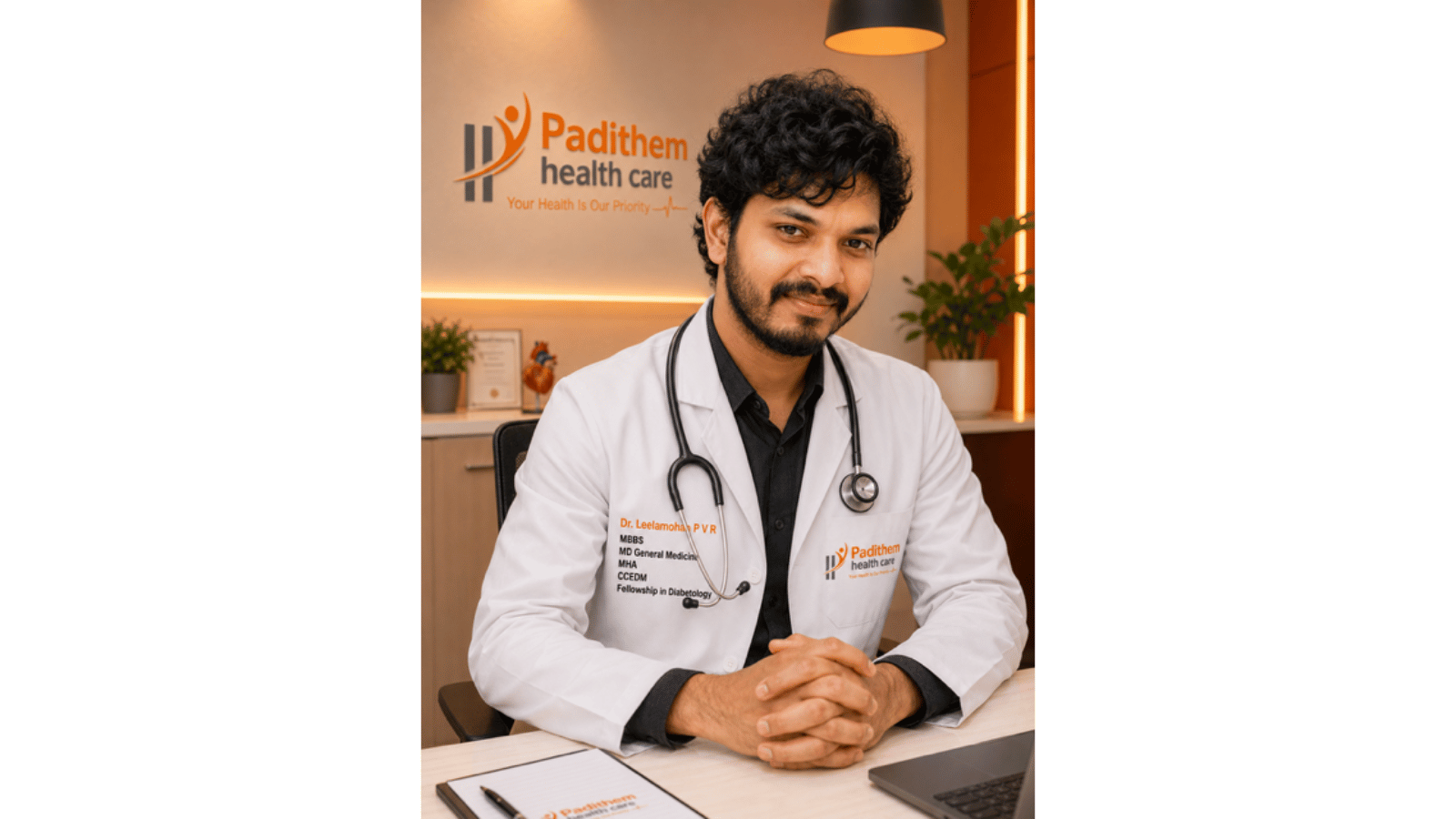
Critical Diabetologist and Film Actor Dr Leela Mohan Shares His Insights on Chronic Care and On-Screen Vulnerability With RawScribe
A doctor who spent the hardest months of the pandemic keeping his clinic doors open might seem out of place on a movie set. But the founder of Padithem Health Care sees no contradiction between treating metabolic diseases and acting in regional films. He approaches both with the same quiet observation of human behavior. In his medical practice he focuses on breaking down stubborn dietary myths and using social media to make preventive health make sense to the general public. RawScribe recently spoke with the physician and actor to discuss his dual life in medicine and cinema.
RawScribe – Growing up, your initial creative ambition was rooted in music, yet medicine ultimately became your life’s calling. Looking back at that early inflection point, what was the internal shift that transformed a desire for artistic expression into a lifelong dedication to the clinical sciences?
Dr Leela Mohan: When I look back, I don’t really see music and medicine as two completely different paths. Music was my first language of creativity. It taught me discipline, sensitivity, patience, and, most importantly, the ability to listen. Those qualities eventually became deeply relevant to medicine as well. The shift happened gradually. As I grew older, I became increasingly fascinated by the human body and by the idea that science could be used not merely to understand life, but to preserve it, improve it, and sometimes even give someone a second chance. That sense of purpose began to outweigh my earlier desire to pursue music professionally. I realised that while music allowed me to express myself, medicine gave me an opportunity to make a meaningful difference in another person’s life.
The decision was therefore not about abandoning creativity. It was about finding a different form of expression, one rooted in knowledge, compassion, responsibility, and service. Medicine eventually became my calling because every patient is different, every situation demands thought, and every outcome carries a human story. In many ways, I brought the discipline and emotional sensitivity that music had given me into medicine. Looking back, I feel that my early love for music did not disappear. It became part of the doctor I eventually became.
RawScribe – Practicing critical diabetology requires intense clinical precision, while acting demands raw vulnerability and narrative immersion. How do you mentally transition between the disciplined reality of the consultation room and the unpredictable creative energy of a film set without one compromising the other?
Dr Leela Mohan: I don’t see medicine and acting as two completely separate worlds. In fact, both demand the same fundamental quality from me, being completely present in the moment. As a critical diabetologist, every consultation requires discipline, precision and the ability to make decisions based on science and evidence. There is very little room for distraction because a patient’s health and trust are in my hands. When I enter the consultation room, I consciously put everything else aside and give the patient my complete attention. Acting requires a different kind of presence. I have to let go of that clinical control and allow myself to become vulnerable, observe the character deeply and respond instinctively to the people and circumstances around me. A film set is unpredictable, and sometimes the most authentic moments come from things you cannot completely plan. The transition, for me, happens naturally because I have learned to compartmentalise without disconnecting.
Medicine has taught me discipline, observation and responsibility. Acting has taught me empathy, emotional expression and the courage to explore a different side of myself. I also believe the two professions actually strengthen each other. As a doctor, understanding human behaviour and emotions helps me connect better with patients. As an actor, my years of observing people, their fears, struggles, expressions and vulnerabilities, give me a deeper understanding of human beings. So I don’t feel that one compromises the other. They represent two different forms of connecting with people. In medicine, I try to heal and make a difference in a person’s life. Through cinema, I try to tell stories that make people feel and think.
RawScribe – Preventive healthcare often fails because traditional clinical advice can feel distant and unapproachable. Given your active engagement on digital platforms, how do you use creative storytelling to break down the science of metabolic health and make chronic care management intuitive for the public?
Dr Leela Mohan: For me, preventive healthcare is not just about giving people information. It is about making that information relatable enough for them to act on it. As a diabetologist, I often see that people understand the seriousness of diabetes, obesity, or metabolic disease only after complications appear. I believe we have to change that mindset much earlier. Through digital platforms, I try to translate complex medical concepts into simple, everyday stories. Instead of talking only about insulin resistance, HbA1c, or metabolic syndrome, I connect them to situations people actually experience, what happens when we consistently sleep late, skip exercise, eat mindlessly, or ignore small changes in our health. Storytelling allows the science to become something people can see themselves in.
My creative side also helps me communicate without making healthcare feel intimidating or preachy. Whether it is through a short video, an analogy, humour, or a personal narrative, my aim is to make people pause and think, “This is actually about me.” Ultimately, chronic care is not about one prescription or one consultation. It is about building sustainable habits. If I can make someone understand their health in a simple, engaging way and motivate them to take one small step toward better metabolic health, I feel the digital platform has served its purpose.
RawScribe – During the peak of the global pandemic, your clinic remained continuously accessible, managing high patient volumes through unprecedented uncertainty. Looking back at that trial by fire, how did that experience fundamentally alter your perspective on patient duty, risk, and leadership in healthcare?
Dr Leela Mohan: The pandemic fundamentally changed the way I looked at medicine. Before COVID, we often spoke about patient responsibility in terms of diagnosis, treatment and outcomes. But during those difficult months, I realised that being a doctor also means having the courage to remain present when the situation itself is uncertain. Our clinic continued to remain accessible even when fear was everywhere and the volume of patients was unprecedented. Every consultation carried a degree of risk, not only medically, but personally. Yet, that experience taught me that patients remember your presence as much as your prescription. Sometimes, simply being available, listening calmly and giving them a sense of direction was itself a form of treatment. It also changed my understanding of leadership. Leadership in healthcare is not about giving instructions from a distance. It is about standing with your team and taking responsibility when circumstances are difficult.
You have to protect your staff, make decisions with incomplete information, adapt constantly and, above all, remain composed because your confidence becomes the confidence of the people around you. The pandemic made me more conscious of the privilege and responsibility that comes with being a physician. It taught me that risk cannot always be eliminated, but it can be approached with preparation, compassion and accountability. Most importantly, it reinforced something I believe deeply today: when a patient is frightened and uncertain, a doctor’s duty is not merely to treat the disease, but to become a source of reassurance, clarity and hope.
RawScribe – Chronic conditions like diabetes are often surrounded by pervasive dietary myths and outdated nutritional paradigms. What is the single most common nutritional misconception you continually dismantle in clinical practice, and why does long-term metabolic health require unlearning conventional dietary habits?
Dr Leela Mohan: I think the most common misconception I encounter is that managing diabetes means simply “avoiding sugar” or eating a very restrictive, bland diet. Patients often believe that if they remove sweets, they have solved the problem. But metabolic health is much more complex than that. What I continually try to explain is that the quality, quantity, timing and overall pattern of food matter far more than labelling individual foods as simply “good” or “bad.” Even foods that are traditionally considered healthy can contribute to poor glycaemic control when consumed in excess or in the wrong combination. Long-term metabolic health requires us to unlearn the idea of a temporary “diabetes diet” and instead develop sustainable eating habits that a person can follow for decades. I want my patients to understand food, not fear it.
The goal is not deprivation. It is metabolic awareness, understanding how our choices influence glucose, insulin resistance, body composition and cardiovascular health. For me, successful diabetes care is when a patient no longer asks, “Doctor, am I allowed to eat this?” but begins to ask, “Is this the right choice for my health, and how can I make it work within my lifestyle?” That shift from restriction to understanding is what makes nutritional change sustainable.
RawScribe – From lead roles in conceptual narratives like Gadiyara to portraying layered character shades across regional cinema, your filmography spans diverse narrative spaces. As a medical professional whose day-to-day life is anchored in empathy and clinical precision, what creative challenges or fulfillment do you find when stepping into intensely conflicted, high-friction on-screen personalities?
Dr Leela Mohan: For me, the most fascinating part of acting is the opportunity to step into a personality that may be completely different from who I am in real life. As a doctor, my daily work demands empathy, patience, clinical precision and the ability to understand people at their most vulnerable. Acting, on the other hand, sometimes asks me to explore the opposite end of the emotional spectrum, anger, conflict, insecurity, obsession, ambition or moral ambiguity. I actually see these two worlds as complementary rather than contradictory. Medicine has taught me to observe people closely, their expressions, silences, fears and the reasons behind their behaviour. That observation becomes invaluable when I portray a complex character. I don’t judge the character. I try to understand what made that person become who they are.
That process of finding the emotional truth behind even a difficult personality is what I find most challenging and rewarding. The creative fulfillment comes when I can make the audience feel that the character is a real human being rather than simply a role being performed. Whether it is a lead role in a conceptual narrative like Gadiyara or a layered character in regional cinema, I enjoy discovering those shades of human behaviour that I may not otherwise encounter in my own life. In a way, medicine allows me to understand human beings through reality, while cinema allows me to explore them through imagination, and both ultimately come back to the same thing, understanding the human mind and the human story.
RawScribe – As you continue expanding Padithem Health Care while taking on fresh film roles, your focus spans two distinct fields. Looking ahead, what key milestones do you want your clinic to achieve next, and what kind of acting projects do you plan to pursue?
Dr Leela Mohan: Looking ahead, my vision for Padithem Health Care is to build it into a centre where clinical excellence and preventive healthcare go hand in hand. I want the clinic to grow beyond simply treating disease to become a place where people understand their health, identify metabolic risks early, and receive personalised, evidence based care. Expanding our diagnostic and preventive services, strengthening patient education, and making quality healthcare more accessible are some of the milestones I would like to achieve in the coming years. For me, growth is meaningful only when it translates into better outcomes and a better quality of life for patients. On the acting front, I want to remain selective.
I am not looking at acting merely as another profession, but as a creative space where I can explore different facets of human behaviour. I would like to take up roles that challenge me, characters with emotional depth, moral complexity, psychological conflict, or shades that are very different from my own personality. I am particularly drawn to strong narratives and directors who have something meaningful to say. Medicine gives me a deep understanding of people, while cinema gives me an opportunity to interpret those human experiences through storytelling. I hope to continue growing in both worlds without compromising the commitment and integrity that each one demands.